
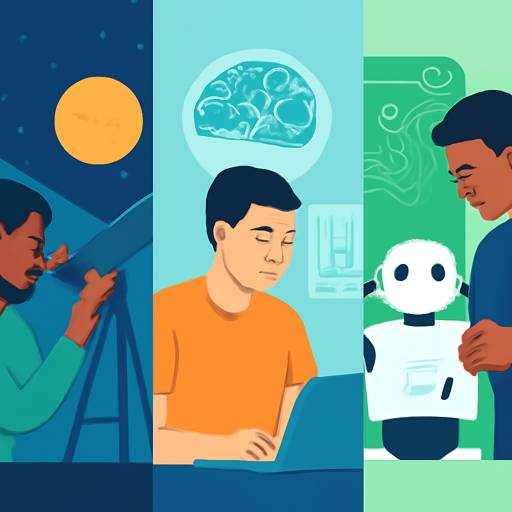
From Stars to Circuits: Ambitious Student Projects in Astronomy, Cognitive Science, and Robotics
Curiosity grows into innovation when ideas are paired with the right tools and a clear plan. Whether charting variable stars, modeling human attention, or choreographing fleets of small robots, students can tackle sophisticated questions with accessible hardware, open datasets, and well-scoped methods. The following sections outline high-impact paths across astronomy research ideas, human-centered experiments, and both humanoid and swarm robots—each designed to sharpen analytical thinking, programming fluency, and scientific communication while producing outcomes worth sharing at fairs, clubs, and conferences.
Astronomy and Space Telescope Projects You Can Start Now
Modern astronomy rewards patient observers and sharp data analysts. Start local with the night sky and scale up to archival Space Telescope Projects as skills mature. A DSLR on a sturdy tripod can measure brightness changes in Cepheids or eclipsing binaries through differential photometry. By recording a target and several comparison stars across multiple nights, students can create light curves, estimate periods, and discuss distance-ladder implications. Low-cost diffraction gratings turn small telescopes into basic spectrographs that separate starlight, letting students classify stars with the Balmer series or monitor changes in emission lines of bright variables.
Remote robotic telescopes extend reach beyond backyard skies. Services that schedule observations let students capture exoplanet transits, star clusters, or galaxies without owning a large instrument. Add rigor by precomputing exposure times, tracking airmass, and calibrating with darks, flats, and biases. For time-domain projects, monitor known transiting exoplanets and model transit depth to approximate planet radius relative to the host star. Pair these observations with open-source tools—image stacking, astrometric alignment, and photometry packages—to standardize workflow and quantify error bars.
Public archives elevate projects from observing to discovery. Explore NASA and ESA databases to analyze Hubble or TESS targets using Python-based notebooks. Lightkurve makes it straightforward to extract and detrend light curves from space missions; students can hunt for transit-like dips, stellar flares, or rotation modulations. In galaxy studies, use multiwavelength images to compare star-forming regions and build color-magnitude diagrams that hint at stellar populations. Contributions to citizen-science communities, including variable star databases and transient alerts, teach proper metadata, reproducibility, and peer feedback—hallmarks of real research.
Radio astronomy opens another frontier. With a software-defined radio and a simple antenna, it is possible to detect the 21-cm hydrogen line and map a slice of the Milky Way’s rotation curve. While the setup takes patience, the payoff is direct engagement with galactic structure. Framing and documenting such work with clear methods, controls, and uncertainty analysis will distinguish a school project as original research, not just a build.
Designing Rigorous High School Cognitive Science
Well-designed behavioral experiments reveal how minds perceive, learn, and decide. Start with a testable hypothesis, measurable outcomes, and an ethical plan for recruiting participants. Classic paradigms such as the Stroop task, visual search, and n-back working memory provide strong entry points. Students can measure reaction times, accuracy, or learning curves across conditions using browser-based tools like PsychoPy (online), jsPsych, or simple custom scripts. Randomization and counterbalancing help prevent order effects, while power-minded sampling improves the chance of detecting true differences.
Data quality matters as much as clever design. Predefine exclusion criteria for outliers, maintain consistent stimuli timing, and pilot test on a small group to weed out interface issues. Use spreadsheets or Python/R to compute descriptive statistics, confidence intervals, and effect sizes—not only p-values. Visualization (density plots, violins, and per-participant traces) can reveal patterns hidden by group means. Model-based approaches, like drift-diffusion models for decision-making or learning-rate fits for reinforcement-learning tasks, add sophistication and connect psychology to computational neuroscience.
Ethics must be integral. Secure informed consent, anonymize data, and avoid sensitive topics without proper oversight. When sampling within a school, guard against coercion by separating data collection from grading contexts. Consider pre-registration on an open platform to lock in hypotheses and analysis plans. This practice promotes transparency and strengthens the project’s credibility in competitions and journals oriented toward student research.
For an integrative path, examine human-robot interaction (HRI): how do interface latency, robot gaze, or voice tone alter trust and task performance? A controlled study can compare variants of feedback timing or embodiment using a simple robot or on-screen agent. For curated project pathways, organizations that support cognitive science for high school often provide mentorship, rubrics, and scaffolds that shorten the ramp from idea to publishable pilot. Linking outcomes to applications—education technology, user interface design, or accessibility—helps communicate broader impact and paves the way for interdisciplinary follow-ups.
Humanoid and Swarm Robotics: From Single-Agent Skills to Collective Intelligence
Building a small biped or upper-torso platform teaches mechanics, control, and perception in one package. Start with off-the-shelf servos, a microcontroller, and 3D-printed brackets. Implement reliable joint control first: calibrate servo ranges, tune PID parameters, and log telemetry. Next, add inverse kinematics to position hands or feet in task space. For locomotion, experiment with gait patterns—static walking for stability, then dynamic gaits managed by center-of-mass targets or zero-moment-point heuristics. Layer on sensing with IMUs for balance and cameras for basic vision (AprilTags, face detection), then explore HRI through speech commands or gesture recognition. These steps transform humanoid robotics for students from an assembly challenge into a research platform for motion planning and interaction.
Swarm robotics flips the script: instead of one complex robot, coordinate many simple agents. Begin with compact wheeled robots equipped with distance sensors and a low-power radio (BLE mesh, ZigBee, or ESP-NOW). Implement local rules—separation, alignment, cohesion—to reproduce flocking behaviors, then move to formation control via consensus algorithms. Map these rules to graph theory: each robot communicates with neighbors to update headings, maintain spacing, or vote on targets. For real tasks, try area coverage with frontier exploration, cooperative object transport using force-sharing, or multi-robot path planning with collision avoidance. Keep communication protocols robust with heartbeat messages and graceful degradation when nodes drop.
Simulation accelerates iteration before hardware trials. Test algorithms in Webots, Gazebo, or CoppeliaSim, then validate on a physical subset. Performance metrics such as time-to-coverage, energy per task, and resilience to failures help quantify progress. A compelling capstone combines both domains: a humanoid guides or supervises a swarm—issuing high-level goals while the collective handles exploration or retrieval. This architecture mirrors real-world warehouse and disaster-response pipelines where one sophisticated agent orchestrates many specialized units.
Case studies show what’s achievable in a semester. A five-robot swarm can demonstrate warehouse-inspired picking by assigning goods via market-based task allocation, minimizing total travel while tolerating communication outages. A bipedal platform can perform pick-and-place on color-coded objects using vision-based grasp selection, benchmarking success rate against lighting changes. Blending disciplines enriches outcomes: apply cognitive load theory to HRI by measuring how interface complexity affects operator error across swarm sizes, or borrow distributed sensing ideas from astronomy (monitoring many sky patches) to design redundant coverage patterns. With thoughtful scoping, Swarm robotics student projects and single-robot builds alike generate publishable insights and portfolios that stand out in competitive programs and early research labs.
