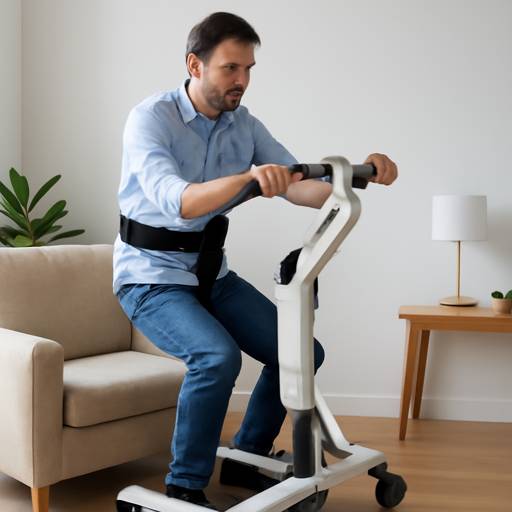
The transition from a seated to a standing position is something most people take for granted. For individuals recovering from surgery, living with chronic conditions like arthritis, or dealing with age-related muscle weakness, this simple act can become a daunting and dangerous task. The physical strain placed on both the patient and the caregiver during manual transfers is immense. This is where the specialized equipment designed for partial weight-bearing transfers becomes invaluable. A sit to stand lift is not merely a piece of medical equipment; it is a bridge to independence and a tool for safer, more dignified care. When you explore the market for a sit to stand lift for sale, you are investing in a device engineered to work with the patient’s natural ability, rather than replacing it entirely. Unlike a full-body sling lift that hoists a non-weight-bearing individual, a sit-to-stand lift supports the torso and knees, encouraging the patient to actively participate in the transfer. This active engagement is crucial for maintaining muscle tone, improving circulation, and preserving a sense of autonomy. For caregivers, the benefits are equally profound. The ergonomic design of these lifts drastically reduces the risk of back injuries and chronic strain that often come with manually lifting or supporting a patient. By providing a stable, pivot-based mechanism, these lifts make daily tasks like moving from a wheelchair to a bedside commode or from a chair to a physical therapy mat significantly safer and more predictable. The decision to purchase such a device should be driven by a clear understanding of the patient’s weight-bearing capabilities and the specific environments where the lift will be used.
Understanding the Mechanics and Medical Necessity of Sit-to-Stand Technology
The core engineering of a sit-to-stand lift is focused on biomechanical efficiency. The unit typically consists of a sturdy, wheeled base, a vertical mast, and a specialized sling or harness that supports the patient under the arms and around the back. The patient starts in a seated position, with their feet placed on a footplate. A padded knee support is then positioned against their knees to prevent the legs from sliding forward during the lift. The lift mechanism, whether hydraulic, battery-powered, or manual, then raises the patient’s torso in a smooth, controlled arc, bringing them to a near-standing posture. It is critical to understand that this is not a vertical lift; it mimics the natural forward-lean of a person standing up. This motion is therapeutically valuable because it encourages core engagement and weight-bearing through the legs. Medical professionals often prescribe these lifts for patients who have "sit-to-stand" ability, meaning they have enough leg and trunk strength to assist with the transfer but lack the stability or endurance to do it independently. This includes patients with spinal cord injuries at lower levels, post-operative hip or knee replacements, and neurological conditions like Parkinson’s disease. When searching for a sit to stand lift for sale, one must carefully consider the weight capacity, which commonly ranges from 300 to 500 pounds, and the type of sling. Some slings are disposable for hygiene reasons, while others are reusable and washable. The base width is another crucial factor; a wider base offers greater stability but may not fit through standard doorways, while a narrower base increases maneuverability. The integration of these mechanical features directly impacts the safety and comfort of the transfer, making it imperative to choose a model that aligns with the patient’s specific size and the spatial constraints of their living environment. An often-overlooked aspect is the pivot range of the lift. Higher-end models offer a 360-degree base pivot, allowing for seamless turning without having to reposition the entire lift, which is a significant advantage in tight spaces like a hospital bathroom or a small assisted living apartment.
Reducing Caregiver Burnout and Enhancing Facility Safety Protocols
In both home care and institutional settings, the physical toll on caregivers is a leading cause of employee turnover and worker's compensation claims. Manually performing a sit-to-stand transfer, even for a patient who can bear some weight, involves awkward postures, sudden loads, and high forces on the lower back. A study on nursing injuries consistently identifies patient handling as the primary source of musculoskeletal disorders. The adoption of a mechanical sit-to-stand lift is a direct countermeasure to this risk. By shifting the physical work from the caregiver’s muscles to the machine, the lift eliminates the shear force and torque that cause injury. For a home caregiver, often a family member with no formal training, this can be the difference between being able to provide care and suffering a debilitating injury that ends the arrangement. In a skilled nursing facility or rehabilitation center, having multiple units available ensures that staff can perform transfers quickly and safely, maintaining a high standard of care without sacrificing their own health. The use of these lifts also streamlines the process of toileting, dressing, and repositioning. A patient can be transferred from bed to wheelchair, then to a commode, and back in minutes with minimal physical strain. When you look at a sit to stand lift for sale for a facility, you are not just buying hardware; you are investing in a safety culture. Many modern units come with features like digital weight scales integrated into the frame, allowing for effortless daily weight checks without moving the patient to a separate scale. This is a small but powerful example of how the technology serves multiple clinical purposes. The durability of the equipment is also a key consideration. Commercial-grade lifts from reputable manufacturers are built with sealed bearings, non-corrosive metals, and heavy-duty casters that can withstand thousands of transfer cycles. This longevity makes them a cost-effective solution for institutional budgets, reducing the total cost of ownership over the lift's lifespan. Training staff on proper use is straightforward, as the controls are usually intuitive, featuring simple up/down buttons or a hand control pendant.
Real-World Applications: Case Studies in Versatile Patient Care
The value of a sit-to-stand lift becomes truly apparent when examined through specific patient scenarios. Consider the case of an 78-year-old woman named Eleanor recovering from a total hip replacement. The standard post-operative protocol strictly prohibits hip flexion beyond a certain angle for weeks. Manual assistance to stand is not only painful for her but also risky, as an accidental twist could dislocate the new joint. A sit-to-stand lift with a wide-splay base and a comfortable, wrap-around sling allows her to stand and pivot to her wheelchair without violating her surgical precautions. The lift supports the majority of her weight initially, and as she gains strength, she can push more using her legs, accelerating her physical therapy progress. This active participation is critical; it prevents the muscle atrophy that would occur if she were fully lifted by a sling. In another instance, a rehabilitation center used a sit-to-stand lift for a patient with progressive multiple sclerosis. While the patient could still bear weight, she had severe fatigue and poor balance. The lift provided the stability needed to complete her standing transfers multiple times a day for toileting, which preserved her dignity and reduced the risk of falls in the bathroom. For the caregivers, the lift meant they could assist her without needing two people, freeing up the second staff member for other duties. When evaluating sit to stand lift for sale options for a home care patient, a case study might focus on the environment. A patient living in a smaller house with narrow hallways benefits from a model with a compact footprint and a battery-powered motor, which eliminates the need for a trailing power cord that could be a trip hazard or limit range. The ability to lower the knee pads to the floor is another real-world feature that simplifies the process of positioning the patient, especially if they are in a low-seated sofa or a recliner. These practical examples illustrate that the lift is not a one-size-fits-all device. The selection process should be guided by the patient’s diagnosis, their living situation, and the specific transfer challenges they face daily. The integration of these lifts into a comprehensive care plan often results in measurable improvements in patient mood and cooperation, as they feel safer and more in control of their own movements.